
Updated November 2026
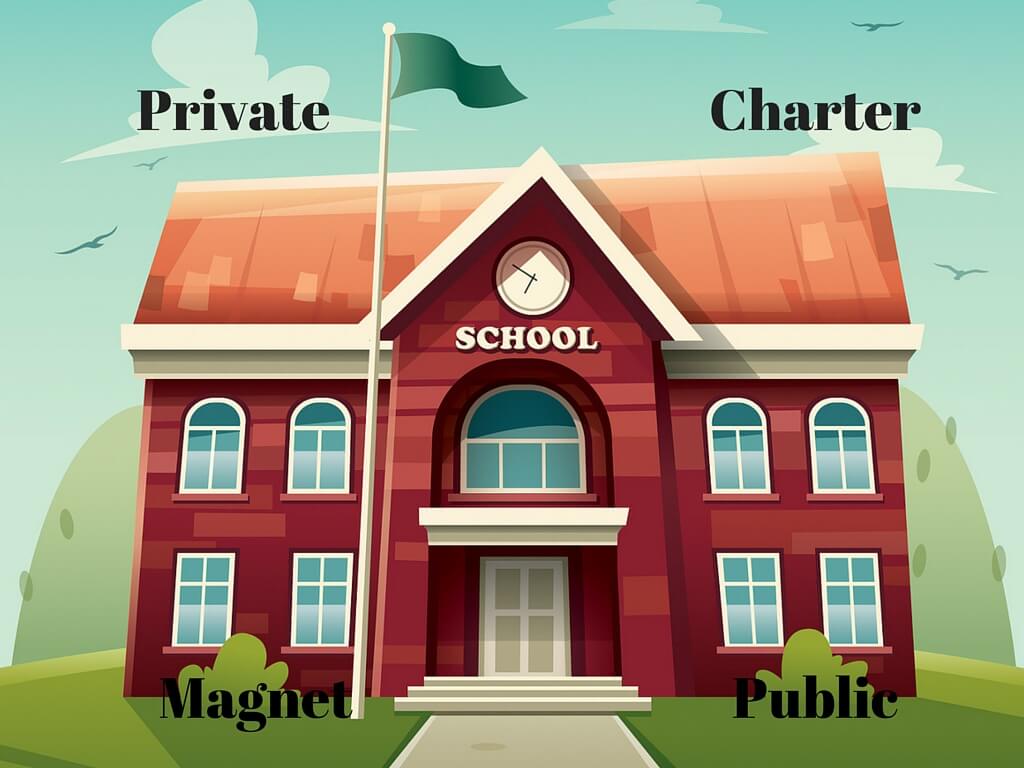
Parents have more school options than ever, but understanding the differences can be confusing. Traditional public schools, charter schools, magnet schools, and private schools each offer different approaches to education.
Which type is best for your child?
The answer depends on your student’s academic needs, interests, learning style, and the environment in which they’re most likely to succeed.
Let’s look at the differences.
Traditional Public Schools
Traditional public schools are publicly funded and tuition-free. Most students attend schools assigned according to where they live, although some districts offer transfer and school-choice options.
Public schools generally follow state curriculum standards, assessment requirements, and accountability systems.
One advantage is the variety of academic programs, extracurricular activities, athletics, and support services that may be available, particularly in larger districts.
However, the experience can vary considerably from one school to another. Class sizes, academic offerings, resources, and the amount of individualized attention students receive may differ even within the same district.
Charter Schools
Charter schools are also publicly funded and tuition-free, but they operate with greater independence than many traditional public schools.
A charter school operates under an agreement with an authorizing organization that establishes its educational mission and performance expectations.
This flexibility may allow charter schools to develop specialized curricula, distinctive teaching methods, or different school schedules.
Unlike many neighborhood public schools, charter schools typically require families to apply. When applications exceed available seats, students are generally selected through a lottery rather than academic admissions testing.
Charter schools remain accountable to public education requirements and must meet the conditions of their charters.
Magnet Schools
Magnet schools are public schools offering specialized academic programs designed to attract students with particular interests or educational goals.
Common magnet-school specialties include STEM, performing arts, foreign languages, health sciences, and career-focused education.
Like charter schools, magnet schools offer families alternatives to their assigned neighborhood schools. However, magnet programs are generally operated within public school districts rather than through independent charter organizations.
Admissions procedures vary. Some magnet schools use lotteries, while others have academic requirements, auditions, or other selection criteria.
For a student with a strong interest in a particular subject, a magnet school may offer educational experiences that are difficult to find elsewhere.
But specialized programming doesn’t necessarily mean a school is the right fit for every student. Families should also consider the school’s instructional approach, workload, learning environment, and available support.
Private Schools
Private schools operate independently from public school districts and generally charge tuition. They may be nonprofit or for-profit, religious or nonreligious, and can vary substantially in their educational philosophies.
Many private schools have greater flexibility in curriculum, scheduling, classroom organization, and instructional methods.
Some emphasize college preparation, religious education, specialized academic programs, or particular teaching approaches.
Because private schools establish their own admissions requirements, families should carefully evaluate whether a school’s educational model is appropriate for their student.
Tuition is an important consideration. However, financial aid, school scholarships, and education-choice programs may help some families manage the cost.
For example, Texas introduced its Education Freedom Accounts (TEFA) program for the 2026–27 school year, offering education funding to eligible, awarded students attending participating schools. Funding is limited and subject to program requirements.
Learn more about Texas Education Freedom Accounts
Which Type of School Is Best for Your Child?
It’s tempting to compare school types based primarily on test scores, reputations, or tuition costs. But those measures don’t always reveal how successful a particular student will be in a specific learning environment.
When evaluating schools, consider questions such as:
- Does the student need more individual attention or greater academic challenge?
- Would a specialized academic program match the student’s interests?
- How well does the school support students who learn differently?
- What classroom environment helps the student stay engaged?
- How important are extracurricular activities, flexibility, and school culture?
- Does the school have an instructional approach that fits the student’s needs?
No single school type is automatically best for every child. The goal is to find the school where your student is most likely to learn, grow, and succeed.
Watch: Are Magnet Schools Better Than Private Schools?
Magnet schools are an appealing option for many families, but how do they compare with private schools?
In this TenneyTube video, we explore magnet-school programs and discuss considerations for families choosing between different educational environments.
How The Tenney School Approaches Individualized Education
At The Tenney School in Houston, Texas, we take a different approach to classroom instruction.
Our students receive one-to-one instruction, working directly with teachers who can adjust lessons to their academic needs, learning pace, and goals.
For students who need a different level of academic support or challenge, this individualized approach can be an important consideration when evaluating school options.
Could Tenney be a good fit for your student?
Our two-minute School Fit Quiz helps us learn more about your student’s needs. A member of our admissions team personally reviews the responses and provides feedback.