


For years, putting a Chromebook or laptop in front of every student seemed like an obvious step forward for schools.
But as Chromebook use in schools became more widespread, we began asking whether constant access to a device was always helping students learn.
Students could access information instantly. Teachers could use online curriculum and educational tools. Assignments could be distributed and submitted electronically. Technology could even help schools personalize instruction for individual students.
There are real benefits to all of those things, and we still use technology every day at The Tenney School.
But over time, we began noticing something else: having constant access to technology was sometimes getting in the way of learning—even when students were using the technology for exactly what it was intended for.
A student encounters a difficult question and immediately searches for the answer.
They can’t remember something, so they look it up.
They aren’t sure how to begin writing something, so they turn to AI for help.
None of those actions necessarily represents misuse of technology. Knowing how to find information and use emerging technology is an important skill.
But finding an answer and understanding an answer are not the same thing.
That’s one reason we’ve changed how we use technology at Tenney.
The short version: The Tenney School hasn’t stopped using technology. We’ve changed when we use it. Research and public discussion about attention and digital distraction, combined with what we’ve observed teaching students one-to-one, have convinced us that a computer should be used when it improves learning—not simply because every student has one.
Why Are Schools Rethinking Constant Access to Technology?
The conversation about children and technology has changed considerably in recent years.
Phones and social media have received much of the attention. Social psychologist Jonathan Haidt, for example, has argued that smartphones and social media have fundamentally changed childhood, introducing constant distraction and digital environments deliberately designed to hold users’ attention.
Those concerns aren’t exactly the same as the question of Chromebooks in schools. But they raise an important question for educators:
What happens when we make a digital device the constant companion to learning?
For a broader discussion of technology, attention and childhood, watch Jonathan Haidt’s conversation with Mel Robbins.
Watch the discussion
Are Chromebooks Really the Same as Phones?
No. And we shouldn’t pretend they are.
A school-issued Chromebook is primarily an educational tool. Schools also have considerably more ability to manage and restrict a Chromebook than they do a student’s personal phone.
But the distinction has become less clear.
A modern Chromebook provides a web browser, video, games, messaging, search, multiple tabs, AI tools and access to an enormous range of online content.
Schools can use filters and administrative controls to limit some of those distractions. We do.
But it is difficult to eliminate every distraction from a device designed to access the internet.
More importantly, students don’t have to be deliberately misusing a computer for it to affect the learning process.
When we’re trying to teach something difficult, we want as much of the student’s attention as possible directed toward the teacher, the material, and the thinking we’re asking the student to do.
What Does the Research Say About Technology in the Classroom?
Some researchers are raising a more direct concern about educational technology itself.
Neuroscientist and former teacher Jared Cooney Horvath made that case forcefully in recent testimony before the U.S. Senate. Horvath argues that large-scale adoption of digital technology in schools has not produced the learning gains educators expected and points to research associating greater school-based technology use with weaker academic outcomes.
His broader argument is particularly relevant to us at Tenney: technology should serve the learning process rather than causing us to redesign learning around the technology.
We don’t need to accept every claim about educational technology to think that’s a useful standard.
See how neuroscientist and educator Jared Cooney Horvath explains his concerns about screens, learning and children’s cognitive development in testimony before the U.S. Senate.
Watch the testimony →
Can Technology Make Learning Too Easy?
Our concern at Tenney goes beyond distraction.
One of the things we’ve become increasingly interested in is what actually has to happen for a student to learn something.
Learning isn’t simply the transfer of information from a screen, book or teacher into a student’s brain.
Students need to pay attention. They need to think about new information. They need to connect it to things they already know. They need to retrieve information they’ve learned before. And sometimes they need to struggle with a problem before they understand it.
That struggle isn’t necessarily evidence that learning has failed.
Sometimes the struggle is part of the learning.
Imagine that I ask a student a question and the student doesn’t immediately know the answer.
With a Chromebook open, the student can solve that problem within seconds. Search Google. Look back through digital notes. Ask an AI tool.
And the correct answer appears.
But I may have wanted the student to search somewhere else first:
their own memory.
If they couldn’t remember, I may have wanted them to think about the question, make connections, try an answer, be wrong, get feedback and try again.
Those processes take longer than Google.
They’re also part of how we learn.
Where Should a Student Turn When They Don’t Understand Something?
Technology has created another subtle change in the classroom.
When students don’t understand something, their first instinct increasingly can be to turn toward technology.
That isn’t necessarily bad. There are extraordinary educational resources available to students, and AI is making personalized explanations more accessible than ever.
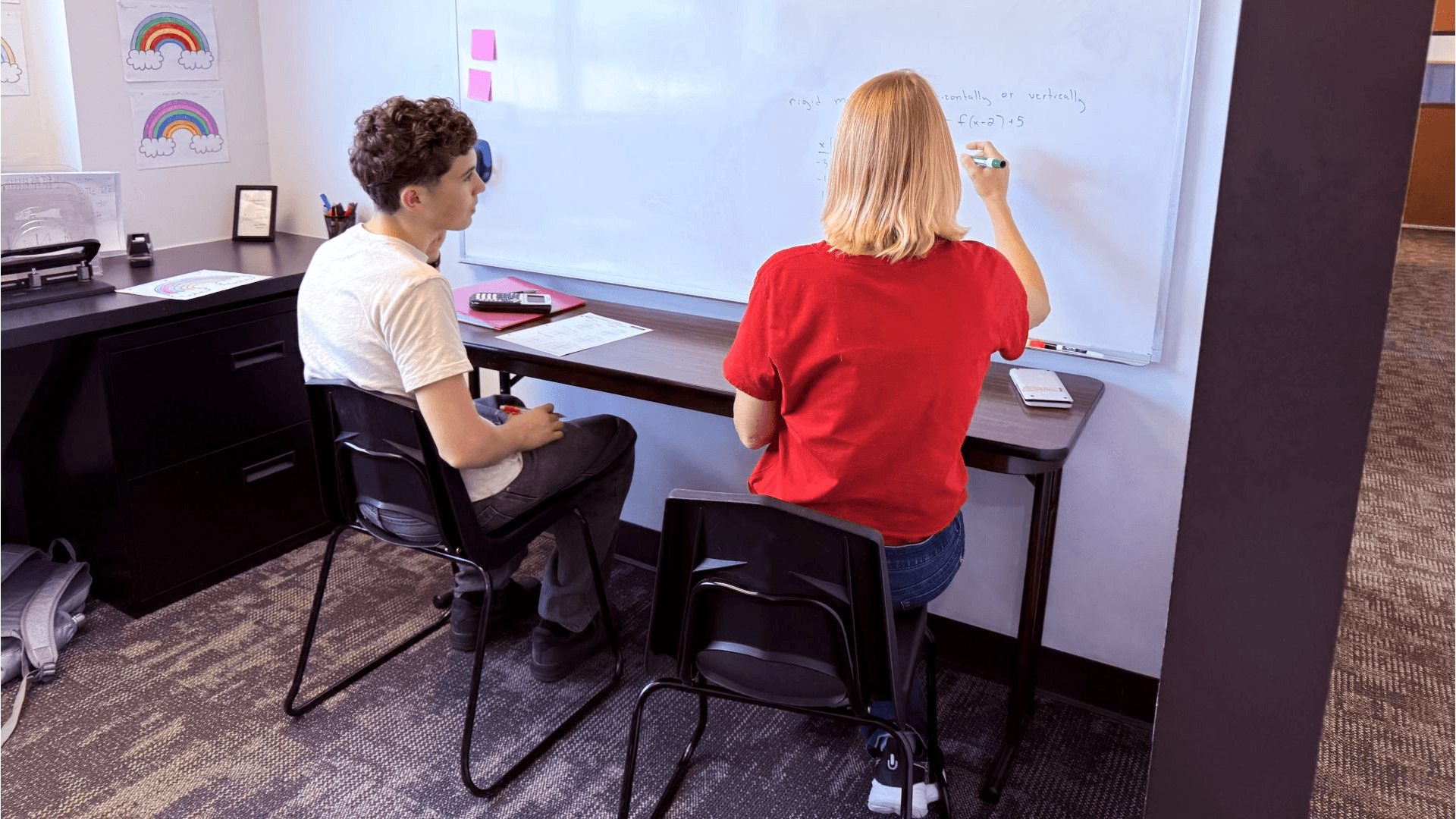
But at Tenney, there’s usually another resource sitting directly across the table:
a teacher.
If a student doesn’t understand an algebra problem, we don’t necessarily want their first move to be searching online for another explanation.
We want the teacher to see why the student doesn’t understand.
Maybe the student is missing a prerequisite skill.
Maybe they understand the mathematics but misread the question.
Maybe they need another example.
Or maybe they actually understand the material and simply need to be pushed to work through the problem themselves.
Those are very different instructional situations.
A good teacher can tell the difference.
And at Tenney, that teacher isn’t trying to diagnose the needs of 25 students simultaneously.
They’re teaching one student at a time.
Why Did The Tenney School Change Its Chromebook Policy?
Eventually, we decided the question we were asking was backward.
Instead of asking:
Why shouldn’t this student have a Chromebook open?
we began asking:
Why should this student have a Chromebook open for this lesson?
That doesn’t mean the answer is always no.
It means technology needs a reason to be there.
Does Tenney Still Use Technology?
Absolutely.
Our students still use computers for research, writing, specialized programs, digital resources, assessments and many other purposes. They also need to learn how to use emerging technologies—including AI—responsibly and effectively.
We aren’t trying to recreate school before computers.
We’ve simply changed the default.
The Chromebook is a tool rather than the learning environment.
If a computer makes a lesson better, we should use it.
If paper and pencil make the lesson better, use those.
If a physical book is better, use the book.
And sometimes the best tool is no technology at all. It’s a student sitting across from a teacher, thinking through a difficult question.
What Does “One-to-One” Mean at The Tenney School?
There’s an important distinction here because the phrase one-to-one means something very different at Tenney than it does at many schools.
In education technology, “one-to-one” often means one device for every student.
At The Tenney School, one-to-one means one teacher working with one student.
We haven’t moved away from personalized education. If anything, reducing our dependence on devices allows us to lean more heavily into it.
One reason schools have embraced educational technology is that software can help differentiate instruction among students working at different levels and speeds.
That’s a legitimate challenge in a conventional classroom.
Our instructional model gives us another way to solve it.
A Tenney teacher can change the pace of a lesson immediately. Ask another question. Go back to something the student hasn’t mastered. Skip something the student already knows. Change the explanation. Push a student who is ready for more.
We don’t need a computer to tell us that a student is struggling.
The teacher is right there.
Technology Should Earn Its Place in the Lesson
Technology isn’t inherently good or bad for learning.
The better question is:
Does this technology help this student learn this material better right now?
If the answer is yes, we want to use it.
If the answer is no, there shouldn’t be a Chromebook sitting in front of the student simply because that’s how school is done.
Our students are growing up in a world where information—and increasingly answers—are available almost instantly.
That makes knowing how to use technology important.
It may make knowing when to put technology aside and think even more important.